Monday, December 7, 2015

The Green Sand Beach

One of only four in the world! A cinder cone turned into beachfront property!

http://www.bigislandhikes.com/papakolea-green-sand-beach/

" A geologic oddity among few in the world, a green sand beach is located in a bay cut by the ocean into a side of Puʻu Mahana, a cinder cone that erupted about 50,000 years ago. The green sand is created by a common silicate deposit of Big Island lava called olivine, which stays deposited on this beach because it is heavier than the other, lighter components of the lava."


What a great hike getting in. There are locals at the parking lot who will give a ride in to whomever will pay, but we preferred to walk. Another chance to see the ocean and the coast. Plus, this one is for you Becca, a striking example of what unrestricted driving on the land can do.


Jeeps and trucks have worn a road 3-4 feet deep in the sand here!

When on path in to the beach gets too rutted, the jeeps just take another path.

We made the hike there in one hour and ten minutes. The sand is sparkling with Olivine. Wish I could say I made the climb down to the beach, but I was just to pooped and also concerned about getting back before sunset. I was told that the beach just glistens with the Olivine.


So, if I understand this correctly, this is one of only 4 places in the world where a volcano cone has eroded by water and created a beach.

On our hike back we were offered a ride by a young couple from California. They are visiting family here who live in the same development where we are staying. Just one road downhill from us! We're on Boki. They are on Carissa.

I asked how they like waking up to the roosters crowing. "What roosters?, they said."  What they hear are the wild pigs looking for food all around their house, and the other homes in the area! That, I have not heard. I'll take the roosters!

Another nice sunset:


Sunday, December 6, 2015

Hawaii Volcano and Turtles

Today we will once again traverse the southern area of the Big Island for a hiking trek near Kilaeua Cauldron. We checked the webpage of the Hawaii Volcanoes National Park before we left home (http://www.nps.gov/havo/planyourvisit/lava2.htm) to find out the condition of the volcano. They actually have a webcam mounted so you can see what’s going on in real time: http://hvo.wr.usgs.gov/cams/panorama.php?cam=KIcam.

As we drive to the other side of the island, I want to write a little, and share this bird photo with you. In addition to all the beautiful fish we saw while snorkeling, we have also seen some different birds than we have back in Illinois. But, to my surprise, we also have seen Illinois’ state bird, the cardinal! There is an ‘ukulele song called Yellow Bird that I learned with the Ukulele Macomb group, but I don’t know what bird that song refers to. I have seen several different yellow birds in the past few days. Here is one I photographed:


I saw another yellow bird yesterday that had a white ring around its eye. I’ve seen other birds that have yellow markings….time to get a bird guide….

I recently learned that the location of the Hawaiian islands may have been guessed at by the Polynesians by observing the golden plover. This little bird migrates between Polynesia and Alaska every year, using Hawaii as a stopover, approximately halfway between the two destinations (2,500 miles either way!).

On the way to the volcano we stopped at a black sand beach to see the sea turtles. There were a couple of beached ones, and plenty more in the water. It was a bit too rough to go into the water, but often a turtle would bob its head above water. That was hard to get a photo of, and I tried to make a clip of a part of a video - the turtle's head was above water for about 1 second! You will just have to take my word for it. But here is a photo of one of the beached ones. Hopefully we will swim with the turtles soon and I will be able to post a video then.


Then, on to the park! After entering the park, we drove straight to the trailhead for the 4-mile Kilauea Iki Crater trail. Going counter-clockwise around the crater, you get to walk through tree ferns in a rainforest for the first mile or two, then you step down loose lava rocks into the crater itself.

Starting our hike in the fern tree rainforest
View of the crater from the rainforest
Zooming in on the scene so you can see the people hiking across the crater

How to get across the crater without getting lost


Example of rocks from aforementioned sign 

About halfway across the crater, there is a steam vent, which you can peer into if you wish, but there isn’t much to see – a crevice in the rock with steam coming out. We thought the crater floor would be unbearably hot, but there was a nice cool breeze blowing the entire time, and it didn’t take as long to cross as we first thought it would.
Steam Vent

We were happy to find out that this trail took us right to the Thurston Lava Tube before we returned to the parking lot where we had left the car. This lava tube was formed when hot lava once flowed downslope towards the ocean – the exterior of the flow cooled while the interior remained hot and fluid, and continued moving down, leaving the emptied lava tunnel behind. It reminded me of walking through a cave. Apparently early Hawaiians have used these fairly common formations as places of refuge and as burial caves. Some lava tubes are many miles long.


It was a wonderful hike altogether, and now we head back to the Kona side of the island, where we should be before the sun sets.

Sun through clouds as seen from Ocean View on our way "home"
Sunset from our deck

Saturday, December 5, 2015

South Point and HOVE

Today, we made a foray further south from our "neighborhood" - and further south on the island than either of us have been before.

We headed toward Ocean View, which has also been known as "Hawaii Ocean View Estates" - someone we met the other day advised us that there would be an ukulele jam group meeting at the L&L Drive-in there. Well, the half-hour drive along a beautiful, scenic road, brought us directly to the L&L Drive-in, where a small band was setting up to perform. In the adjacent parking lot there was a flea market going on, but nowhere in sight or sound was there any jamming going on. Oh well, we had a good time meeting some "locals" (some of whom are transplants from the "mainland").

Afterwards, the day was still young, so we headed out towards South Point - the southernmost point in the United States. By itself, this might not be a very dramatic notion, but the southern tip of this island is the site of churning ocean waters, with a current that heads, uninterrupted, straight towards Antartica. It is believed that this was the entry point to Hawaii for the first Polynesians who came and settled here. The fishing is very rich, and we saw some fishermen at work when we were there today. We were most impressed with the wave action on the windward (east) side of the point.


A local collecting seafood.

Mari at South Point


Another spectacular sunset tonight:


After a trip back home and a late lunch, we decided we needed just a little bit more exercise. So we drove down the hill to Pebble Beach, so we could take a bit easier stroll on "King's Trail", out of curiosity. We could see this broad trail from up the hill, and just wondered where it went. Well, after a false start on the actual tail, which was covered with weeds, we tried a different, unmarked path, which we nicknamed "People's Trail". It led to a "secret" beach where one young couple was hanging out - he was sea-fishing, and she was lying on the beach enjoying a good book. There was actually a flush toilet installed at this secret hideaway! Further beyond this point the People's Trail merged back with the King's Trail and the weeds were gone. According to a guide book, this trail circumnavigates the entire island, more or less. 

Finally, we headed back home to unwind and relax - just in time for the beautiful sunset Ron captured in the photos above.

Boat hoist (see picture below). The concrete pad was the jumping point.
Some people jumped off the cliff near South Point, then climbed up a ladder installed near a boat hoist there. We were told the water was warm. Too bad we didn't bring our suits, huh?


There is a constant wind at South Point

Friday, December 4, 2015

Stinky Fruit and an Eye Exam

Today was supposed to be a 'rest day' after our big hike yesterday. I, (Ron) wanted to schedule an annual vision check-up, and found an approved provider in Kailua. After getting that scheduled for early afternoon, we decided to walk down the hill in our neighborhood to the shore, which is named Pebble Beach.

This has got to be the longest and steepest hill I've ever seen a neighborhood built on. The driveways to some of the houses are incredibly steep, like our house, for example. After getting the car up the hill, then there are the 45 steps up to the house.

Anyway, we hiked down, finding flowers and butterflies to distract us all the way down.


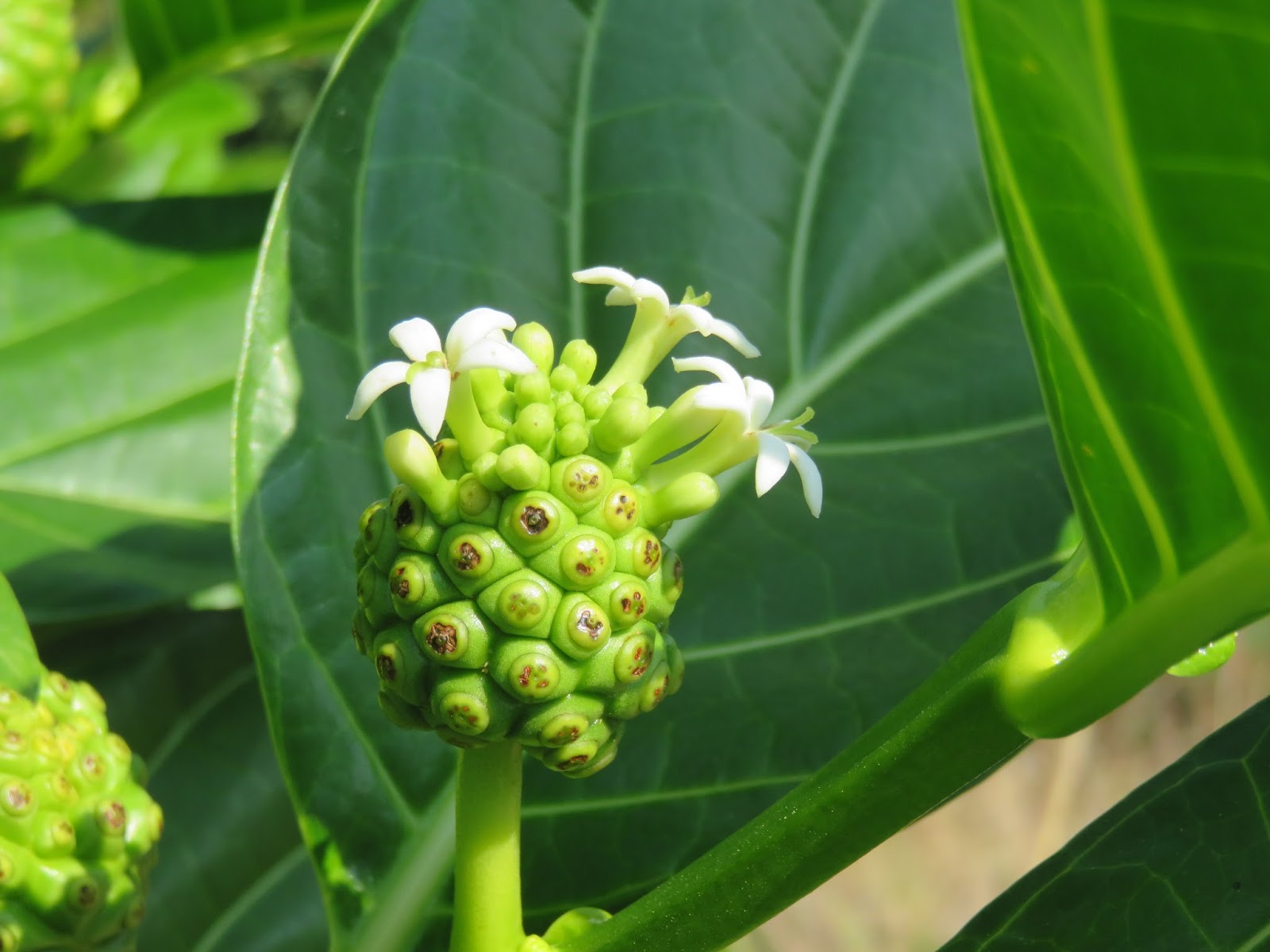
This fruit of this plant, which is very common here, is called Noni, but is also aptly named the Stinky Fruit. It was brought over by the Polynesians as a medicinal and very handy plant for its wood. Here is an excerpt from an article on it:

"The College of Tropical Agriculture and Human Resources at the University of Hawaii, Manoa, lists traditional ways in which noni was used. Meat was wrapped in the wide, glossy leaves and cooked, or the leaves were made into a tea to treat malaria, reduce fever, or act as a pain reliever. A poultice was applied for tuberculosis, sprains, deep bruising, rheumatism, fever, stings from stonefish, bone fractures, and dislocations. The stem was used in canoe parts, paddles, axe and adze handles. Stems were also used as digging sticks, firewood, and made into a red pigment used to dye clothing. Seeds were used as a scalp insecticide and insect repellent; flowers for sties, and roots were used for carving or made into a yellow pigment.
Although the ancient Hawaiians didn’t know it then, research indicates that the ripe fruit contains 165 beneficial compounds. They did know it was effective, and used it to cure sores or scabs around or in the mouth, as a sore throat gargle (mashed), for peeling or cracking of the toes and feet (crushed), body or intestinal worms, cuts, wounds, abscesses, mouth and gum infections, toothaches, and as an appetite and brain stimulant.
Today, proponents of natural medicine and many residents of Hawaii, consume whole noni fruit or juice to relieve ADD/ADHD, addictions, allergies, arthritis, asthma, brain problems, burns, cancer, cardiovascular disease, chemical sensitivity, chronic fatigue, diabetes, digestive problems, endometriosis, fibromyalgia, gout, hypertension, immune deficiency, infection, inflammation, jet lag, multiple sclerosis, muscle and joint pain, polio, rheumatism, severed fingers, sinus, and in veterinary medicine."
So, we had our walk and I exhausted myself again coming back up the hill.

Our house is one of the ones up close to the top of the hill! Walking to the beach is no trivial journey!

So, after lunch and a shower we headed into Kailua for my eye exam. The optometrist grew up in Chicago, on the near north side, in the Rush street area, around Ginos Pizza. He said he went to sleep at night listening to the sound of the barkers trying to direct people into their bars.  I knew exactly the area he was referring to. It's not far from where Second City was, one of the original training grounds for comedians such as John Belushi. He said his mom was a single parent and worked as an exotic dancer in those bars. I was probably just a mile or two north of them at that time, on Fullerton street, attending McCormick Theological Seminary. Small, strange world.


Thursday, December 3, 2015

Hawaii, Continued

Seen on the patio this morning:
Gekkos - lots of gekkos

I saw a gekko catch a yellow moth as I gazed out the kitchen window - the yellow fluttering of the moth's wings caught my eye - immediately it was caught on the gekko's tongue - hanging there as the gekko decided what to do next - a littler gekko was following it - perhaps learning an important lesson about hunting. In an instant, the larger gekko disappeared at the base of the post it was on - and then out of sight!

Today we took a "grueling" 2 mile hike downhill to Kealekekua Bay (1:10) where the snorkeling is famed for its richness.
Well, at least we weren't hiking on this!!!!

We snorkeled for about an hour, rested and ate a snack, and then headed back uphill in the afternoon heat (1:40). We are exhausted, but the snorkeling was, indeed, wonderful.

Here is a small clip of what we viewed today:

We are glad we followed all precautions, such as taking and drinking plenty of water, taking snacks, using sunscreen, and wearing hiking shoes. This hike is not for the casual tourist, and even though it is overall a shorter roundtrip than our usual 4.5 mile hike around Lake Argyle, with its seven somewhat steep hills, it was much more difficult. I am glad I had my walking stick, although Ron did not have his. Three different times, my foot slipped on loose rocks, and I basically sat down to avoid falling or twisting my ankle.

Here we are halfway back up the hill, and quite ready to be to the top already!
1:10 hike down the mountain, 1 hour of snorkeling, halfway back up the mountain - about 45 minutes left to go!

Beautiful Kealekekua Bay

But, oohhh, the snorkeling!!!!! I saw many different multi-colored fish. You can see some of them in this short video above. I do not know the names of all the fish I saw, but if someone asked me which ones I saw, I might answer "all of them!".  In addition to the small-ish fish in this video, I saw some that were at least ten inches long and almost as wide - neon colored blues and greens, deep reddish-purple, spots, stripes, and patterns of all sorts. And I saw some interesting thin, long (about 8 to 10") fish close to the surface of the water - they had snout-like noses and were silver, I think.

A really neat experience was when I got about 30 feet or so from the shore, and the ocean floor dropped away so that you couldn't see it any more. The water was a deep lapis-lazuli blue - the "deep blue sea" - it was mesmerizing to view. Turning back toward shore, you could see a sort of "wall of coral".

Ron told me that he has seen much brighter colors of coral before, and was concerned about the whiteness and lack of color of the coral. He read that the coral all around Hawaii is losing its color as a defense against the warming of the ocean due to climate change. It is sad to think we may be the last generation see this amazing ecosystem.

Here is an article he found that explains what is happening: http://www.mikesevernsdiving.com/blog/2015/10/coral-bleaching-is-that-white-coral-dead/.

We did get to see a brief sunset after we returned home this afternoon. It was a bright red ball of sun setting behind some strands of clouds.


Life saver near Pebble Beach
The developed area where we are staying is on the road to Kahoe Bay. We drove down the road this morning before leaving for Kealekekua Bay, just to have a look around. At the base is Pebble Beach. It is not one of the more touristy sites, and is even said to have the steepest drop to the ocean of anywhere on the Big Island. Although someone told us yesterday: "Don't swim in that bay, there is a strong current", after viewing the waves this morning, well, you can judge for yourself if you would try a swim in this water:

Pebble Beach at Kaohe Bay


Here are some other sights from the past day:
"Da Poke" is tuna tartare. We tried the local smoked pork - delicious. Also, the spicy crab salad was good.
Even though you are driving on a "highway", you really can't drive very fast, so everything takes longer than you might suppose. We are close to mile marker 96 on Mamaloa Highway, if you want to find us on a map. It is close to Pebble Beach at Kaohe Bay.
Across the road from where we had lunch

Funny Sign

Centipedes around here can be dangerous - their stings are poisonous. We saw many of them for about the first half or so of our hike - they seemed to prefer the grassy area to the rocks.


Wednesday, December 2, 2015

Snorkeling in Kealakekua Bay

http://www.tripadvisor.com/Attraction_Review-g60580-d109549-Reviews-Kealakekua_Bay-Captain_Cook_Island_of_Hawaii_Hawaii.html

You can click on the above link to read a little about where we snorkeled today. It was an unexpected visit from someone sent out from an insurance company to photograph the house we are staying in that gave us the idea to get going.

She said she had be down close to Kealakekua Bay, working, and saw people swimming and playing with the Dolphins. That's all it took to get us moving in that direction.

Mari also asked her if she know anywhere where locals gather to play and jam on the Ukulele. "Sure, she said, In my town of Ocean View, at the L&L Drive Inn." Saturdays at 9:00 am! We'll be there.

The snorkeling was great. We'll go back again tomorrow and hike to 2 miles downhill to the Captain Cook Monument. This is said to be one of the best spots on the island to snorkel. Then we'll hike the 2 miles and 1600 feet of elevation change to get back out again.


Aloha!

It was an early rise before dawn on Tuesday, a not-too-bad drive through LA, and non-eventful check-in at the airport as we made this next leg of our journey west.


Even though everything went smoothly, it was still a long and tiring day of travel to get to our beautiful vacation home overlooking the Pacific Ocean. Once on the Big Island of Hawaii, we still had to stock up on provisions and drive the slow, highway road nearly an hour south of Kona. Although we gained two hours in our day, we still were not able to make it to the house before dark. Nevertheless, it was exciting to trek up those 30+ steps from the driveway to the front door of the house, and slowly discover the lovely house where we will be staying for the next five weeks.

Ahhhhh! At last! ...And nothing else on the agenda but to sit on the deck looking out at the ocean, and enjoying the night breeze in the quiet calm.

This morning, before the sun had come up over the volcano mount behind us, this is what it looked like out our front deck:


As the sun rose, the birds became more active, and now we hear lots of different bird sounds all around.

We've noticed papaya, coconut, and avocado trees around the deck. Hope we get to try some of these.