Friday, December 11, 2015

Grindz - the Special Hawaii Food Edition

We are taking time out from our regularly scheduled vacation, to bring you this update on Local Food.

Let's begin with the word grindz - we have seen it in several places, not just coffeehouses, so Ron got curious about it - what could it mean? Turns out, it is a Hawaiian slang term for food.

Well, anyone who has ever been to Hawaii, or listened to certain ukulele songs, has heard of that paste-y staple, poi, may know that it is made from the taro root, and is eaten as a starchy side dish to pork, fish, or whatever. The taro root was brought to this island by the early Polynesian discoverers.

But, there are many more indigenous edibles, there will be no way to cover them all here, but we will share what we've learned so far, during our slightly-more-than-one-week stay. There are a lot of wild pigs roaming around this island, and the Hawaiians prepare their pork in a few different ways. So far, we have had pulled pork, which is prepared the same way we do back home. Although it is not served with barbecue sauce, and it may be wrapped up in a type of seaweed, which was explained to us to be sort of "Hawaiian spinach". We also had a type of smoked (we think) pork, that has been sliced into chunks and has a sweetness to it. It's really delicious. Ron found this at a roadside stand nearby (at the Miloli'i junction). Don't remember what it's called.

Yesterday we stopped at a roadside stand called "The Hotdog Guy". Mari had an all-beef hotdog, and instead of going with her usual mustard and ketchup (sorry Chicago-dog fans), she tried the lilikoi-ghost chili sauce.  Lilikoi is the local name for passionfruit. It was delicious - and reminded her of jalapeno jelly she once made. Ron had the reindeer dog. Yes, reindeer - all the way from Alaska, just like the owner of the stand. He is looking forward to opening a stand at the Home Depot in Hilo next year.

Most visitors are shocked by the high prices of most groceries on the islands. But, if you love fish, you are in for a real treat, because there are all sorts available. When down at South Point last week, we saw a bunch of silver fish jump out of the water together. There were fishermen there at the time. Not sure if any of them caught these fish, but we think they were working on it. We think they are the ones called opelu - or a type of mackerel. You can buy dried opelu at roadside stands.

At the local grocery store, Mari decided to try some different bananas. The yellow ones in the photo are apple-bananas, and they have a tangy character to them. The green-and-white striped ones can be eaten raw, or fried in oil just like plantain. We are going to try that for supper tonight.

In addition to some larger grocery stores, mostly in the larger towns, there are many many small mom-and-pop stores. They can be found in the small towns as well as along the roadside. People also sell dried fish and fresh fruit at many roadside stands.

Kona has a reputation for its coffee, and there is a lot of it everywhere around. Around the southern tip, you get into another region, known as Kau. They also grow coffee, and it is slightly more "rough" tasting. I am not as big a coffee-drinker as Ron, so I couldn't tell much difference - I just put cream and sweetener in it like always, and it all tastes about the same. (Alright, I will admit that Ron has a pretty good coffee-making process at home - and it is the best coffee I've ever had.)

We keep seeing signs stating "Cherry-pickers wanted". I had to think about it for awhile, but do you suppose they mean coffee-cherries?

Also- there is a "Help Wanted" sign up the road at the Macadamia nut farm, if you know of anyone who wants a job on the Big Island!

We haven't tried the local wine yet, but were quite surprised to find out that there is some. At the higher elevation on the east side of the island you can get "Volcano Wine". They add other fruit to it besides grapes. So, you can get Hawaiian guava-grape wine, or macadamia nut-honey wine. The volcano-red wine has jaboticaba berries blended into it. The "Symphony Mele" white wine is comprised of 100% Symphony grapes, which were bred in California to be grown in hot regions.

At the top of the hill to our neighborhood, where all the mailboxes are located, there is a cardboard box that simply says "Fruit". Apparently, you can "take a fruit or leave fruit". There was a ripe lemon in there the other day. We've been eating fresh avocados that fall from the tree onto our deck almost daily. There is also a passionfruit vine that has given us a couple of fruits so far.

There is much more we could write about local foods, and we probably will include those in future posts.  In the meantime, may all your meals be tasty.


Special Fungi Edition

Yesterday we took a short walk through Volcano Tree State Park. Volcano trees are formed when lava piles up against a tree. After the tree is long gone, the vertical column formed by the backup remains:


True, the formation of a lava tree is interesting, but not nearly so much as the various fungi and flora in this nice little State Park.


Sunset through the Vog

We learned that Vog is a mixture of water vapor, carbon dioxide, and sulfur dioxide. Kilauea releases 2,500 tons of sulfur dioxide DAILY! The vog washes over the west (Kona) coast, where we are staying. We haven't noticed any sulfur smell in the air, but we have noticed the very red suns at sunset, and the layer of vog (we didn't really know that's what it was, though it seemed fog-like).

Here are a couple of photos:
We saw this confluence of vog and clouds as we rounded the southern part of the island, heading west this afternoon. The vog originates from Mount Kilaeua and is blown to the west side of the island by the prevailing trade winds from the northeast.

The Vog is the hazy layer above the horizon - this is shortly after sunset today.

Whereas this has contributed to the beauty of the sunsets, some people are sensitive to the sulfur in the air, and people are cautioned about it before seriously considering a move to this island.

There is s vog report here: http://www.konaweb.com/vog/

Here are the levels and how they are determined:
Vog Levels:
  • Extreme - Very reduced visibility, no visible horizon. Blue/grey tint to objects a mile or less in distance.
  • Heavy - Reduced visibility, horizon barely visible. Blue/grey tint to objects 3 miles away.
  • Moderate - Horizon is blurry. Blue/grey tint to objects 5 miles away.
  • Light - Horizon is almost sharp. Blue/grey tint to objects 10 miles away.
  • No Vog - Sharp horizon and there is little haze when viewing distant objects

Anyway, here is a link to a 10-minute sunset video Mari took last night at a nearby village named Miloli'i.

Sunset at Miloli'i Beach


Enjoy!

Thursday, December 10, 2015

Snorkeling in the Tide Pools

Up and out by 8:00 AM for a 2-hour drive to Kapoho Bay Tide pools, on the east side of the island. We found them to be crystal clear and teeming with tropical fish. Here is a link to one of Mari's GoPro videos:

Snorkel in Kapoho Bay Tide Pools


For fun and Games, here's a small sample of some of the common tropical fish seen in the Hawaiian waters, maybe you can find some of these fish in the video:


for extra fun, here's a coral id chart:


All the pretty colors you see on the above coral chart are no longer visible. All the coral we see is covered in white goo, which I understand to be a stress reaction to the warmer water. We are losing a world treasure, the magnificent coral reefs, and the tropical fish that feed on the algae that grow on them. This is the beginning of one of the ocean food chains. The loss of the coral will be felt all the way up the food chain.

The water was not as warm here as on the west side, where all our previous snorkeling has been, but we're being picky. It was still pretty nice. We stayed in for about 30 minutes. Its just so mesmerizing watching the fish swim and feed. They seem not to be one bit concerned about our presence.

We hauled ourselves out and headed on down the road to Issac Hale Beach Park, home of a warm swimming hole, heated by the volcano, of course.


The water was nicely warm. We shared the pool with a man from back east on the mainland who's life work was building drystone walls, like this one:


He has a home here. He said he trained here for the Peace Corps back in 1968, and has wanted to come back ever since. He said, "It took me 40 years, but I made it." He said he would start a business here if he could, but he could never compete with the Tongan Stonemasons. He said they are the size of Sumo wrestlers and work in a team of 15. Really strong and fast.

Ok, YOU try and find a picture of  Tongan Stone Masons! They are hefty, even with flowers in their hair!

We had a nice chat in the pool and he suggested a "Don't Miss" place to visit: the telescopes up at 9,000 feet on Mauna Kea. We're adding that to our agenda for next week.

We got out, dried off and started back home, through a beautiful woods:


Wednesday, December 9, 2015

Relaxing Day with a Little Excitement

The day started out very laid-back. We decided not to take any adventures today, but just hang out, for the most part. We ran an errand in Captain Cook, one of the nearest towns, and stopped at the locally-owned Fujihara "Quick-Stop" style store on the way back. There are lots of local shops, restaurants, and road-side stands on the main ring road, Mamalahoa Highway.

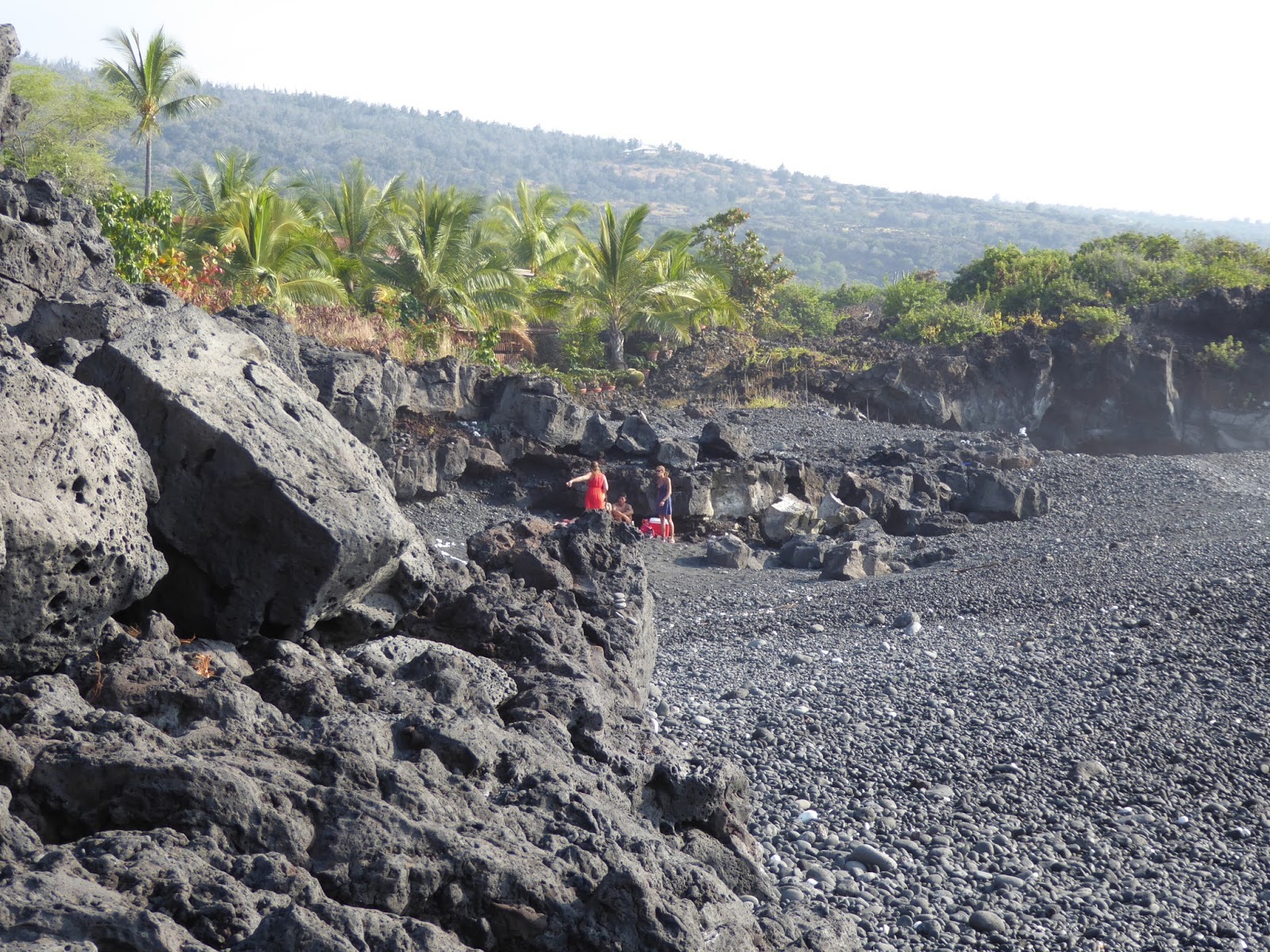
Back at the house, we snacked on lunch and decided to visit the beach at the bottom of the hill, Pebble Beach at Kahoe Bay. If conditions allowed, which they often don't, we might boogie board or snorkel. But, when we arrived we could quickly tell the waves were bigger than they had been on our previous two visits, and it would not be enjoyable doing either of those activities. So, we decided to lay out on our towels for awhile, listening to the crashing waves.

Big waves at Pebble Beach
After about 10 minutes or so of this, we noticed a couple of heads bobbing in the water on the other end of the beach. We could not tell whether they were just having fun getting carried up and down on the waves, or if they were in trouble. The guy would occasionally "swim" a little, but a wave would come up and lift them both up, and then pull them out a little ways. Soon, another man and woman that were near us on the beach, were also looking in their direction. We began discussing whether they were in trouble or not, because they weren't flailing their arms or calling out for help. Yet, the water looked very dangerous, and could quickly exhaust someone who was trying to swim in.

Suddenly, another guy showed up, and among us we grabbed the two life savers that were hanging near the beach. The guys tried to throw them out, but the ropes were too short, and the waves kept bringing them back in. We motioned for the two to move to the center of the bay, instead of out to the side, where they had been all this time. The wave action was less severe there. During this process, two of the people trying to help lost their sunglasses, and one-and-a-half pairs of flip-flops were lost. All of us at some point had been swept over by the massive waves. But we had all heard stories of drownings when one person tries to save another. It usually does not end well for either person.

This young couple, who had only known each other for a week, were very lucky. Because after they got to the middle area, the waves became low for about a minute, and they were gently pushed into the shore. One of the rescuers suggested we get them some water, so I went over to where they had a cooler full of drinks - all of them alcoholic. When I came back to the young couple, one of the men had told them they were very lucky, and the young man said "I live on luck!"

Later, he told two women who were concerned about them, that his girlfriend had given up 15 minutes before we all started trying to help them. I don't think it was that long, but she certainly didn't look like she had been trying to swim. I think the waves were way too strong, and it was all they could do to keep their heads above water. I think all of us expected them to go under at any moment.

In the meantime, neighbors by the beach had called 9-1-1, who said they still needed to come, even though the people had gotten out of the water, because they could still drown if they had inhaled water into their lungs.

The tide was coming in by now, and the waves were washing up even higher on shore, so we all went to our respective homes. Two of the people who had tried to help rescue the young couple were from Austria, and are staying in this neighborhood. The other man who had helped, was staying in the neighborhood with his wife, and another woman who had called 9-1-1 was from Arizona.
Ron looking for a flip-flop that may have washed ashore....


The waves were really big and strong on the left end of the bay. We first saw the two heads bobbing near those rocks over there.

Two concerned women went to talk to the young couple after they were safely out of the water. They are both from Hawaii, both 22 years old.


Here is a photo of the tide coming in at Pebble Beach, shortly after the incident described above. Those were powerful, high waves!

Special Critter Edition

So, there is the issue of critters......


Mari watched this happen during our breakfast yesterday. Its a Gecko-eat-Lizard world around here.

When Mari and I were at the Flea Market in Ocean View last Saturday I met a woman who was singing the praises of the French Fries the local Thai Food vendor made. I was so impressed I ordered some too. While were waiting I asked a few questions about her house. She lives at the Ocean View Ranchos. Those are houses built on 3-acre lots between the highway and the ocean. She choose one that isn't up too high so she wouldn't have so many steps to climb. "But, she added, the higher you lift them up off the ground the fewer problems you have with critters. getting in."

I didn't pursue the critter issue with her, but I have learned more about it. One of the critters you don't want to mess with around here is the centipede with the poisonous bite.


There are 3 common centipedes here. The one with the poisonous bite is said to have a brown head and a dark green body. Its bite can send you to the hospital.

Stories about encounters with centipedes abound. Just Google "Hawaii Centipedes" and you can entertain yourself for hours reading about people's encounters with them.

Here is one such account:

"My daughter, Priscilla, can kill a centipede with a butcher knife or scissors all by herself. She is an adult with children who are looking to her for protection -- if Daddy is at work -- when a centipede crawls into the livingroom. But if her husband, Daniel, is home she grabs the biggest knife she can find and hands it to him when one of these fast-slithering creatures from hell enters the family domain. Daniel then has the honor of hacking the thing in half. Then he cuts it in quarters.
Just the other night Priscilla and I were talking on the telephone. Her husband was at work. All of a sudden, Priscilla screamed. I could hear her panic and fast breathing plus muted words and sounds for about two minutes. "Priscilla, Priscilla?" I said. I had heard her say the word centipede so I knew it wasn't a human intruder, but a centipede situation. Finally she came back on the line. She said there had been a centipede in the kitchen. She hadn't seen it and had accidentally stepped on it but luckily got her foot free before the thing attacked. She grabbed the kitchen tongs and picked the creature up, got it outside and hacked it up. (I am glad she took it outside to do this -- this time -- because recently I heard that the scent of a cut up centipede brings more centipedes to the area.)
Centipedes don't stop moving just because you cut them up. They fight to the end. They look like they are coming to get you! That's because they are coming to get you! Their pinchers are still pinching for several minutes after the body is lying in pieces, writhing on the floor. Daniel has pestered a sliced-up centipede after the execution and by poking a pencil at the pinchers has found that a centipede can keep up the attack mode for six minutes after being sliced into four pieces. This is information that, hopefully, you will never need. And as I mentioned, my daughter is capable of carrying out the execution on a centipede herself. She does not back away (or stand on the table and scream for help) if her husband is not home when the centipede is discovered in their condo. She says it actually gives her a feeling of confidence to know that she is now capable of doing this herself whenever necessary. I will never know that feeling of confidence, but that's okay."
Not everyone recommends killing centipedes. Many recommend just throwing them outdoors. After all, they eat the cockroaches, which can get big around here. Mari saw one the other day, down in the laundry area under the house that was 2 inches long. 
Here is a note I sent to the owner of the house we are staying in a few days ago:
"I just took a centipede and some other worm-like thing out of the first floor tub. Ants are coming in through the kitchen window. My wife found one of those large cuban cockroaches in the laundry last night and a dead cockroach on the kitchen floor just a few minutes ago."
Here was his response:
"LOL we are living on their island! "
"Things happen really really really slow here I have been waiting for Terminix to call me back for a month. The only things that sting are the centipedes everything else is ugly but harmless."
So, I was discussing the critter situation with a person we have met here. She stopped by yesterday to say hi. She said that when she cleans her house she never moves or lifts anything, especially if its in a corner. 

Pigs:  If you hear sounds at night, its likely the pigs looking around your house for food.
"...with their boundless appetites and unchecked fertility, Eurasian feral pigs, Sus scrofa, are the worst of the worst. These are not the little Asian domesticated pigs that Native Hawaiians farmed for centuries, but descendants of the big European swine that started getting loose and going native after Captain Cook put Hawaii on the map in 1778.
“They rototill the planet,” Dr. David Duffy, a biology professor at the University of Hawaii, told me. On my visit in February, he and Dr. Thane Pratt, an authority on Hawaiian forest birds, explained the problem. Feral pigs eat native plants and, through their scat, spread invasive ones like the forest-clotting strawberry guava. Indirectly, they slaughter birds — the stagnant, mucky wallows they dig breed mosquitoes that carry avian malaria.
Their only redeeming trait is that they are delicious,"


Here's a news article from the next town south of where we are staying:
"Wild pigs are becoming a problem in Mililani Mauka. They’re going into people’s yards and destroying property.
The normally quiet subdivision has been disturbed lately with the loud snorts of feral pigs, looking for something to eat.
“I’ve seen them at night, early in the morning, midday. Like right now, they might come walking through,” said resident Andrew Deal.
Residents sent us video and said the pigs are getting more accustomed to being around people, so it’s not unusual to find them out roaming on the street or even on their properties.
They say they’ve seen as many as 17 at one time, and are usually feeding on their plants.
“It was covered. The whole rock was covered with that plant, but now (there’s barely any) left,” said resident Miyo Deal.
A trail has been formed by wild pigs coming up from the gulch and straight into people’s yards.
Mililani Town Association’s general manager, Dave O’Neal, says they can do more than just damage your property.
“Within the last year in Mililani Pines, a boar actually attacked got trapped in a homeowner’s yard and gouged a man in his leg and had to go to the hospital so they can definitely be dangerous,” he said.
After KHON2 told him about the recent complaints, O’Neal called the Pig Hunters Association of Oahu.
“They might be after the pet’s food sprinklers, go to the water source. It’s a multitude of different things that could be drawing the pigs here,” said vice president Mitchell Tynanes.
Tynanes says wild pigs start getting braver at residential areas in search of food and water. He says he can set up what’s known as a pen trap with enough room to hold several pigs.
“I’ll probably talk to the homeowners here so that they could keep an eye on it. That way when I bait it, set it and then when pigs go in, I can take it out as soon as possible,” Tynanes said.
The pigs are then hauled out and taken to a farm. The pig hunters do it for free and, of course, they get to keep the pigs."

So, regarding critters, here's a plan:  1. Get as far off the ground as you can. 2. Clean like you don't really mean it. 3. Lock up your garbage, especially at night. And all your other plants.

Swimming With the Turtles


Today we visited our favorite place for snorkeling, which we discovered during our last visit to Hawaii, in 2011, Kiholo Bay. We called it Turtle Island, because there is a rocky "island" right offshore where the turtles liked to beach themselves. There were also turtles in the bay, along with lots of colorful little fish. The turtles swim around, not fazed at all by your presence.

The last time we were here, the water was quite clear, but today it was cloudy, and you could hardly see a thing. I saw some larger fish (10-12") with a white band around their tail, but that is all I could make out. I saw a few other fish, but nothing like I saw the last time. But - the turtles were there, and we got to swim with them!