Tuesday, December 15, 2015

Journey to the Top: Both of Them

Top Number 1: If you look at the map of the Big Island, you just might see a rough outline of Hawaii's famous Green Sea Turtles. The northernmost part is shaped like a turtle's head, and the flippers can be seen near Hilo and Pahoa on the east side, and on the Kona (west) Coast --- with a little imagination. The "head" area is known as Kohala, and the oldest volcano on the island, Kohala Mountain, is located there.

We drove past Hawi (Pronounced hah -VEE) yesterday for lunch and a hike down the Pololu Valley to the rocky northern shore. According to only us and our imagination, we spent the afternoon at the Turtle's Head.

Hawi is a town that suffered big-time as the Sugar Cane industry pulled out. (If you have the time and interest, the story of Sugar Cane in Hawaii is well worth learning about. Its a sad and sordid story.)

https://en.wikipedia.org/wiki/Sugar_plantations_in_Hawaii

Our stop for lunch was delightful, at the King's View Cafe in Kapa 'au. Mari had a delicious pulled pork sandwich, and I ordered this pizza:


It had a white sauce with a kick. It may have been the juice from the Artichoke hearts. On top of that was dried tomatoes, artichoke hearts, pesto and chicken. Really Yummy! The staff would not reveal the sauce recipe. Darn.

The King referred to in the name of the restaurant, is King Kamehameha, who was responsible for conquering all the people on the Hawaiian Islands and uniting them into one kingdom. There is a nice statue of him looking towards the ocean from across the street of this restaurant. This location is very near his birthplace.

To learn more about him, you can just google his name, or check here:
http://www.gohawaii.com/en/big-island/regions-neighborhoods/north-kohala/kamehameha-statue-kapaau/

King Kamehameha I in Kohala


After that it was on to our hike for the day, which literally started at the end of Highway 270.
View from top of the hike down Pololu Valley Trail at the end of the highway on Kohala's north shore.


It was a short, moderate hike down to a pretty black sand beach and the steady blast of the Trade Winds. We found the wind and waves to be mesmerizing. It was lightly raining while we ate lunch, and for a bit as we drove to the end of the road. As luck would have it, by the time we reached the bottom of the trail, this complete rainbow appeared over the ocean!


There were lots of black crabs hanging out on the rocks.


After an hour of soaking in the sound, sight and feel of the wind and waves, we hiked up and drove on to our other top for the day, Mauna Kea.

https://en.wikipedia.org/wiki/Mauna_Kea


Deemed the best place in world for land-based observatories, some native Hawaiians have protested proposed expansions, due to the historical sacred significance of Mauna Kea.

http://www.huffingtonpost.com/2015/04/13/hawaii-telescope-protests-tmt-
mauna-kea_n_7044164.html

As for our visit, the clouds and crowds made it less than ideal. We left early.

View from our deck. No sunset photo yet. Haven't seen the whales yet, but we hear they are around.
Even though the clouds prevented us from seeing the Milky Way, Mari looked at the stars through her binoculars and was amazed at the numerous stars that were visible - the sky seemed to be thick with stars. She also saw at least one shooting star, this being the tail end of the Geminid Meteor showers.

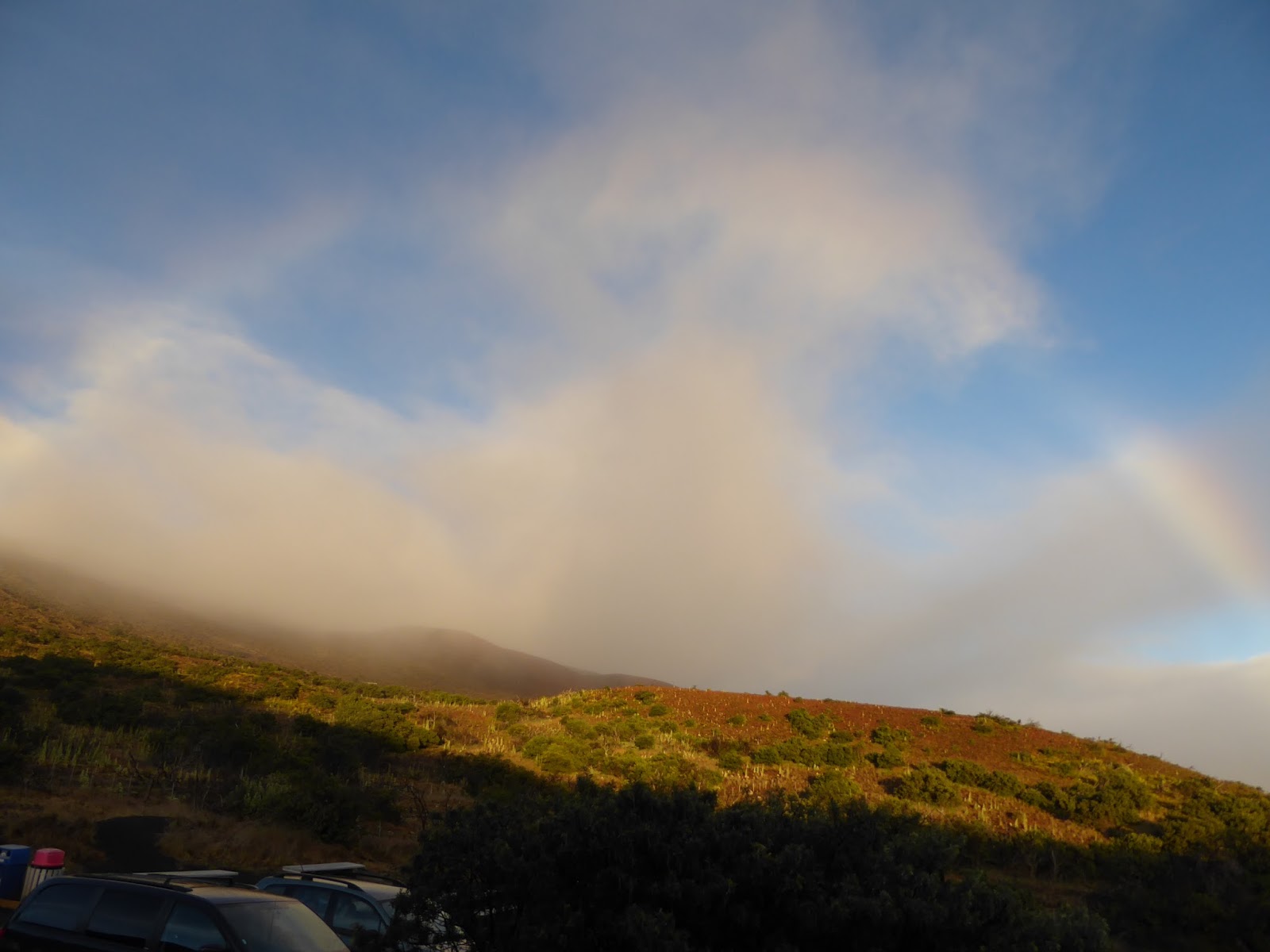
But - it turned out that the first rainbow we saw since we have been in Hawaii, was only the first of FOUR for the day! Here is the final one, seen at the Observatory Visitor Center near the top of Mauna Kea as it started breaking up:


Here is a painted rock seen on the trail to Pololu Valley:


Sunday, December 13, 2015

Gawkers, Slow Walkers and Pot Tokers

The day is only half over and already we have had several nice doings. We started out with a walk on the Manuka State Park Nature Trail. We checked the Trail Guide box as we did the 1st time we hiked this trail. Still empty. We did though, encounter two couples and each of them had trail maps in their hands from previous trips out here. (The Hawaiians really do take recycling seriously). One of the fellows we spoke to identified himself as an entomologist. He knew the latin name of one fruit Mari asked him about, the Thimbleberry. Also known as the West Indian Raspberry:

http://wildlifeofhawaii.com/flowers/892/rubus-rosifolius-west-indian-raspberry/

Mari also asked him about the small, red, apples we see along the trail. "Oh, he said, the Strawberry Guava."

That's a tasty fruit. I've had dozens on them already.


The first time we did this trail we were the Gawkers. Today, we were out for exercise. I felt guilty passing up the gawkers and slow walkers, but we had a different purpose today: Exercise.   We did cross paths with Girly and Pierre. We met them our 1st time out. Pierre lives in the area. Girly is a pound mutt. Nice dog. Pierre's ok too. So, we did stop and chat a bit, until we heard Girly getting in a fight with the dog the Pot Tokers had with them. We met them at the big hole in the ground at the top of the trail. Interrupted their mellow perhaps. Still, we had a nice chat about the dolphins and then we headed on our way. Now I think Girly really did Marsh their Mellow.

Now down to the end of the trail where we stopped to talk with a young couple picnicking on the grass. They both just got their 2nd degrees from the Univ. of Hawaii, (Counseling and Sociology), have just moved over to Kona from Hilo, and are hoping to buy a house soon. We met their two young sons at another picnic table as we walked to our car. Nice boys.

Everyone is so friendly here...

This afternoon we took a brief tour of the National Park here called the Place of Refuge. Its a real-life version of a game we used to play as kids where if you made it to the base then you were safe:

Imagine you had just broken the sacred laws, the kapu, and the only punishment was death.  Your only chance of survival is to elude your pursuers and reach the Pu'uhonua, a place of refuge.  The Pu'uhonua protected the kapu breaker, defeated warriors, as well as civilians during the time of battle.  No harm could come to those who reached the boundaries of the place of refuge.

Place of Refuge


After that, more snorkeling at the beach just outside the park boundaries. We saw the Spinner Dolphins! We haven't seen them up close yet or gotten any video of them, but that's our dream. They rest in these calm bays all day after a night of feeding. Here's someone else's video of them:

Dolphins in Kealakekua Bay


"Spinner dolphins are carnivores. They eat fish and squid. At night, spinner dolphins travel to deeper water to eat. In the morning they move back to shallow water to rest."


That's all for today.


Saturday, December 12, 2015

Two More Days of Adventure

FRIDAY

Yesterday, we made our way up the road to the Makuna Park, where you can hike up through the forest, and then loop back down in an hour-and-a-half or two, depending on how much you dawdle. Along the way, there are many fruits and nuts, including ku kui nut, a small, red fruit another hiker called "apples", but are actually strawberry guava, and lots of passion fruit.


This flowering tree was at the front of the park. Haven't figured it out yet.


Fruits on the red-flowered tree
Another hiker told us these were "apples", and they did taste good - we later learned they are strawberry guava. 
Strawberry Guava
A little less than halfway around the loop trail, there is a large lava pit:


We met a nice young man who was selling flowers at the park shelter. He told us his uncle Lawrence could rent us a kayak down at Kealekekua bay. We did that four years ago when we were on Hawaii, but today we wanted to check out Honomolino Bay, which is quite a bit more off the beaten path.

To get to Honomolino Bay, you first have to take the steep road to Miloli'i, turning downslope at the Miloli'i Junction. People in Miloli'i live close to the land, and have historically been a fishing village. People are trying to help them maintain this traditional skill, but economically, they are not doing so well.

At the bottom, we met a nice woman named Noa, who was tending an itinerant library in the Beach Park there. (She is also a documentarian, making films about the culture of the South Pacific and Hawaiian Islands. Unbeknownst to us, just a day or two earlier, we watched a film she put on YouTube about fishing in Miloli'i. You can view it here: https://www.youtube.com/watch?v=H61-dNuQFus).

When we asked about taking the path to Honomolino Bay, Noa pointed us in the right direction. She told us when we get to the private land that you have to cross, say hello to Sam, her uncle, and tell him Noa says hi. We did walk through an area with "Keep Out" signs, and big yellow arrows painted on the rocks and trees to guide you in the correct direction. We also passed up a very nice-looking private beach. Sorry I didn't get a photo of that. Here is what the hike looked like:
Hiking back to Honomolino Bay
It took about 15-20 minutes to get to Honomolino, a black sand beach, which - guess what - is very hot on a sunny day(!) It's not that we didn't wear the right shoes, but we wanted to go in and do some snorkeling, which means at some point you have to leave your shoes somewhere and put on the fins. Anyway, once we were in the water, all was well. We saw some neat fish - nothing spectacular, but it was nice to know you could get out just beyond the surf-break and hang out, looking underneath you at the entirely different world that exists there.

SATURDAY

We decided last night that we would get up and out of the house early this morning and head over to Kealekekua Bay, where the Spinner dolphins reside. They have been known to do some jumping and playing around in the morning. They hunt and feed at night, but can still be active early in the day.

So, we didi just that. We took a different road to the Bay, going past the Place of Refuge, which we have yet to stop and visit. We'll write more about that later. It was a beautiful drive, starting out as a respectable 2-lane road with a yellow stripe, and narrowing down to a one-lane paved road. Just when it narrowed down to one lane, there were lava stone walls on either side of the road. Later, there were shear drop-offs, due to erosion, I suppose, right alongside the road. No shoulder whatsoever.

Kealekekua Bay in the morning


Anyway, we got to the Bay and a group of people was already there, almost like a party. One car had its stereo up full blast - or so we thought, until they turned it up even louder - then they turned the bass all the way up, so you could hear the thumping from pretty far away. We don't know if the dolphins didn't like the music, or just decided to retire early, but they were a no-show.

Nevermind, we thought. Let's just slip into the water and see how the snorkeling is. It is a rocky entry, but the surf wasn't too bad. We proceeded to snorkel along the coast, heading towards the Captain Cook Monument, which is a long ways away. Not sure how far, but would feasibly take at at least an hour to snorkel there. We didn't set it as a goal, since it seemed somewhat unrealistic, and we didn't want to wear ourselves out. So, we stayed along the shore, just out from the shore break, and snorkeled for about half an hour before turning back. We saw a lot of fish, some of which we hadn't seen - and Ron saw a Manta Ray. We saw schools of fish we hadn't seen before.

We were happily surprised to know that you don't have to hike downhill for over an hour, or rent a kayak and paddle across the bay, just to have a really nice snorkel in Kealekekua Bay. We actually just drove up, parked, changed clothes in the restrooms, and walked down a very short paved walk to the rocky beach, and went in. No fuss no muss!

You can view a higher resolution video on You Tube: 

After snorkeling, we drove up the road to find some breakfast. We found a local cafe-type of place, which turned out to be mediocre, and the coffee was worse (bad coffee in Kona?! Yikes). But the silver lining is that we re-found the music store we found four years ago - Kiernan Music Shop. So happy to find Brian, the owner, and learn about the 'ukulele jam on Thursday mornings down the road a little ways. We also learned a bunch of other good information while chatting with him.
Seen at Kiernan Music Shop
Parasailor seen overhead while on the road today.

Then, it was on to Captain Cook, where we stopped and spent some time at the Amy B. H. Greenwell ethnobotanical garden. Ethnobotany documents the plants people used for food, medicine, dyes, and many other uses. I guess you could say it is "pre-industrial" uses, since so many manufactured goods have replaced traditional products, such as those obtained from plants directly. The Garden also explained which plants were brought to the island by the Polynesians, and which are endemic to the Hawaii Islands.


All in all, it has been a fun, interesting day. And we are glad to be back at our home base, resting up for another day.

Vog rolling into the Kona side in the afternoon.


7:10 PM:  Ron here.  Listening to Prairie Home Companion! We get two NPR stations here, just south of Kailua-Kona. 

Learned today, from the Horticulturalist at the EthnoBotanical Garden  that there are more Hawaiians in California and Las Vegas than there are in Hawaii. Cost of living is too high here for them. Its sad to say, but for them this is now a service economy, as far as I can tell. Grocery store clerks. Post Office clerks. Renting kayaks to tourists. 

Oh, the pigs. Brian, the owner of the music store, had 14 Mango trees cut down on his property. Why? The mangos attract the wild pigs to the yard. They overturn everything, including the nice rock walkways his wife had done. 

Time to kick back. Thanks for listening.

Mahalo,

Ron and Mari


Friday, December 11, 2015

Grindz - the Special Hawaii Food Edition

We are taking time out from our regularly scheduled vacation, to bring you this update on Local Food.

Let's begin with the word grindz - we have seen it in several places, not just coffeehouses, so Ron got curious about it - what could it mean? Turns out, it is a Hawaiian slang term for food.

Well, anyone who has ever been to Hawaii, or listened to certain ukulele songs, has heard of that paste-y staple, poi, may know that it is made from the taro root, and is eaten as a starchy side dish to pork, fish, or whatever. The taro root was brought to this island by the early Polynesian discoverers.

But, there are many more indigenous edibles, there will be no way to cover them all here, but we will share what we've learned so far, during our slightly-more-than-one-week stay. There are a lot of wild pigs roaming around this island, and the Hawaiians prepare their pork in a few different ways. So far, we have had pulled pork, which is prepared the same way we do back home. Although it is not served with barbecue sauce, and it may be wrapped up in a type of seaweed, which was explained to us to be sort of "Hawaiian spinach". We also had a type of smoked (we think) pork, that has been sliced into chunks and has a sweetness to it. It's really delicious. Ron found this at a roadside stand nearby (at the Miloli'i junction). Don't remember what it's called.

Yesterday we stopped at a roadside stand called "The Hotdog Guy". Mari had an all-beef hotdog, and instead of going with her usual mustard and ketchup (sorry Chicago-dog fans), she tried the lilikoi-ghost chili sauce.  Lilikoi is the local name for passionfruit. It was delicious - and reminded her of jalapeno jelly she once made. Ron had the reindeer dog. Yes, reindeer - all the way from Alaska, just like the owner of the stand. He is looking forward to opening a stand at the Home Depot in Hilo next year.

Most visitors are shocked by the high prices of most groceries on the islands. But, if you love fish, you are in for a real treat, because there are all sorts available. When down at South Point last week, we saw a bunch of silver fish jump out of the water together. There were fishermen there at the time. Not sure if any of them caught these fish, but we think they were working on it. We think they are the ones called opelu - or a type of mackerel. You can buy dried opelu at roadside stands.

At the local grocery store, Mari decided to try some different bananas. The yellow ones in the photo are apple-bananas, and they have a tangy character to them. The green-and-white striped ones can be eaten raw, or fried in oil just like plantain. We are going to try that for supper tonight.

In addition to some larger grocery stores, mostly in the larger towns, there are many many small mom-and-pop stores. They can be found in the small towns as well as along the roadside. People also sell dried fish and fresh fruit at many roadside stands.

Kona has a reputation for its coffee, and there is a lot of it everywhere around. Around the southern tip, you get into another region, known as Kau. They also grow coffee, and it is slightly more "rough" tasting. I am not as big a coffee-drinker as Ron, so I couldn't tell much difference - I just put cream and sweetener in it like always, and it all tastes about the same. (Alright, I will admit that Ron has a pretty good coffee-making process at home - and it is the best coffee I've ever had.)

We keep seeing signs stating "Cherry-pickers wanted". I had to think about it for awhile, but do you suppose they mean coffee-cherries?

Also- there is a "Help Wanted" sign up the road at the Macadamia nut farm, if you know of anyone who wants a job on the Big Island!

We haven't tried the local wine yet, but were quite surprised to find out that there is some. At the higher elevation on the east side of the island you can get "Volcano Wine". They add other fruit to it besides grapes. So, you can get Hawaiian guava-grape wine, or macadamia nut-honey wine. The volcano-red wine has jaboticaba berries blended into it. The "Symphony Mele" white wine is comprised of 100% Symphony grapes, which were bred in California to be grown in hot regions.

At the top of the hill to our neighborhood, where all the mailboxes are located, there is a cardboard box that simply says "Fruit". Apparently, you can "take a fruit or leave fruit". There was a ripe lemon in there the other day. We've been eating fresh avocados that fall from the tree onto our deck almost daily. There is also a passionfruit vine that has given us a couple of fruits so far.

There is much more we could write about local foods, and we probably will include those in future posts.  In the meantime, may all your meals be tasty.


Special Fungi Edition

Yesterday we took a short walk through Volcano Tree State Park. Volcano trees are formed when lava piles up against a tree. After the tree is long gone, the vertical column formed by the backup remains:


True, the formation of a lava tree is interesting, but not nearly so much as the various fungi and flora in this nice little State Park.


Sunset through the Vog

We learned that Vog is a mixture of water vapor, carbon dioxide, and sulfur dioxide. Kilauea releases 2,500 tons of sulfur dioxide DAILY! The vog washes over the west (Kona) coast, where we are staying. We haven't noticed any sulfur smell in the air, but we have noticed the very red suns at sunset, and the layer of vog (we didn't really know that's what it was, though it seemed fog-like).

Here are a couple of photos:
We saw this confluence of vog and clouds as we rounded the southern part of the island, heading west this afternoon. The vog originates from Mount Kilaeua and is blown to the west side of the island by the prevailing trade winds from the northeast.

The Vog is the hazy layer above the horizon - this is shortly after sunset today.

Whereas this has contributed to the beauty of the sunsets, some people are sensitive to the sulfur in the air, and people are cautioned about it before seriously considering a move to this island.

There is s vog report here: http://www.konaweb.com/vog/

Here are the levels and how they are determined:
Vog Levels:
  • Extreme - Very reduced visibility, no visible horizon. Blue/grey tint to objects a mile or less in distance.
  • Heavy - Reduced visibility, horizon barely visible. Blue/grey tint to objects 3 miles away.
  • Moderate - Horizon is blurry. Blue/grey tint to objects 5 miles away.
  • Light - Horizon is almost sharp. Blue/grey tint to objects 10 miles away.
  • No Vog - Sharp horizon and there is little haze when viewing distant objects

Anyway, here is a link to a 10-minute sunset video Mari took last night at a nearby village named Miloli'i.

Sunset at Miloli'i Beach


Enjoy!

Thursday, December 10, 2015

Snorkeling in the Tide Pools

Up and out by 8:00 AM for a 2-hour drive to Kapoho Bay Tide pools, on the east side of the island. We found them to be crystal clear and teeming with tropical fish. Here is a link to one of Mari's GoPro videos:

Snorkel in Kapoho Bay Tide Pools


For fun and Games, here's a small sample of some of the common tropical fish seen in the Hawaiian waters, maybe you can find some of these fish in the video:


for extra fun, here's a coral id chart:


All the pretty colors you see on the above coral chart are no longer visible. All the coral we see is covered in white goo, which I understand to be a stress reaction to the warmer water. We are losing a world treasure, the magnificent coral reefs, and the tropical fish that feed on the algae that grow on them. This is the beginning of one of the ocean food chains. The loss of the coral will be felt all the way up the food chain.

The water was not as warm here as on the west side, where all our previous snorkeling has been, but we're being picky. It was still pretty nice. We stayed in for about 30 minutes. Its just so mesmerizing watching the fish swim and feed. They seem not to be one bit concerned about our presence.

We hauled ourselves out and headed on down the road to Issac Hale Beach Park, home of a warm swimming hole, heated by the volcano, of course.


The water was nicely warm. We shared the pool with a man from back east on the mainland who's life work was building drystone walls, like this one:


He has a home here. He said he trained here for the Peace Corps back in 1968, and has wanted to come back ever since. He said, "It took me 40 years, but I made it." He said he would start a business here if he could, but he could never compete with the Tongan Stonemasons. He said they are the size of Sumo wrestlers and work in a team of 15. Really strong and fast.

Ok, YOU try and find a picture of  Tongan Stone Masons! They are hefty, even with flowers in their hair!

We had a nice chat in the pool and he suggested a "Don't Miss" place to visit: the telescopes up at 9,000 feet on Mauna Kea. We're adding that to our agenda for next week.

We got out, dried off and started back home, through a beautiful woods: